
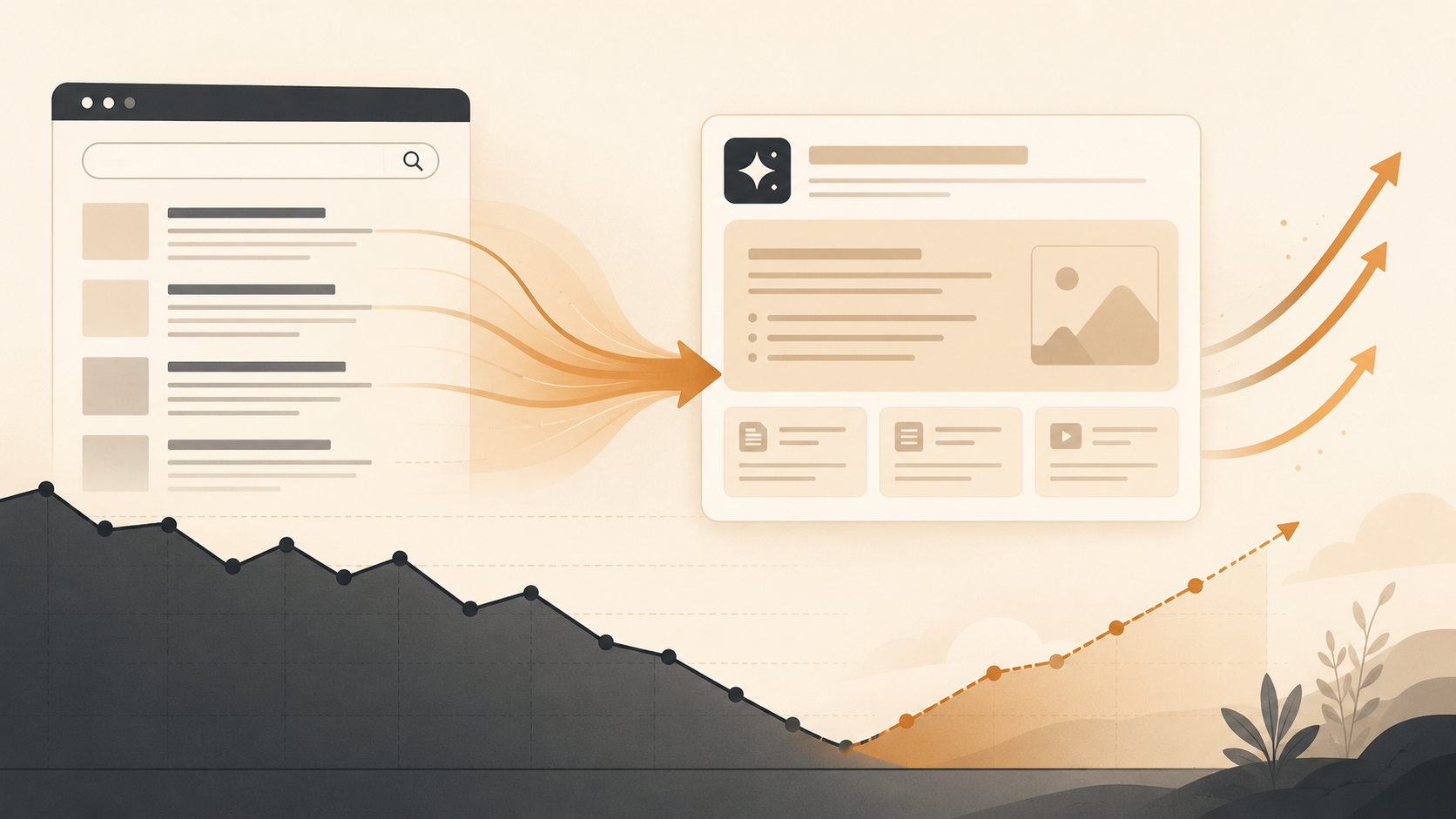
The most effective strategies for recovering organic traffic lost to AI-generated answers centre on earning citations within AI Overviews, restructuring content for direct extraction, and diversifying traffic sources beyond traditional search. These aren't theoretical fixes. Seer Interactive's September 2025 study of 25.1 million organic impressions found that organic CTR plummeted 61% for queries triggering AI Overviews — dropping from 1.76% to just 0.61% (Seer Interactive, 2025). The good news: brands cited within those AI Overviews earned 35% more organic clicks than those left uncited.
"If AI systems don't reference your content, most users will never reach your site — being cited has become the primary pathway to discoverability in search,"— Rand Fishkin, Founder & CEO, SparkToro
That gap between cited and invisible is where your strategy begins.
"Focus on concise, verifiable answers and original data. AI engines prioritize extractable facts with named sources — that's how publishers earn citations and sustain organic traffic,"— Lily Ray, SEO Strategist, Amsive Digital
How bad is the organic traffic decline from AI answers?
The decline is real but unevenly distributed. Similarweb data comparing the top 40,000 U.S. sites showed an overall organic search traffic drop of just 2.5% year-over-year. Yet mid-sized publishers ranked between 100 and 10,000 bore the heaviest losses, while the top 10 sites actually grew organic traffic by 1.6% (Search Engine Land, 2025).
Some household names took severe hits. HubSpot — widely considered an SEO authority — saw a 70–80% decline in organic traffic between late 2024 and 2025, with monthly visits falling from roughly 13.5 million to under 6 million (The Digital Bloom, 2025). Forbes experienced a 40% year-over-year drop in search referral traffic (Digiday, 2025).
Zero-click searches compound the problem. By March 2025, 27.2% of U.S. Google searches ended without a click, up from 24.4% a year earlier. On mobile, that figure hit 77% (SEMrush / Search Engine Land, 2025).
Which strategies actually recover lost organic traffic?
Follow these steps to rebuild visibility in an AI-answer environment:
- Audit which of your keywords trigger AI Overviews. The share of queries generating AI Overviews doubled from 6.49% in January 2025 to 13.14% by March 2025 (SEMrush, 2025). Know where you're exposed.
- Restructure content around the BLUF principle — lead every section with a direct, extractable answer. AI engines pull concise statements, not buried conclusions.
- Embed verifiable statistics with named sources. AI systems prioritise content that includes quantified, attributable claims.
- Build topical authority through content clusters rather than isolated keyword-targeted pages. The top 10 largest sites grew traffic precisely because search engines recognise domain authority signals.
- Diversify acquisition channels. A Datos and SparkToro Q4 2025 report found Google desktop searches per user fell nearly 20% year-over-year, with Google driving clicks for just 44% of searches — down from over 60% a decade earlier (SparkToro, 2025).
How do cited brands compare to uncited brands in AI Overviews?
| Metric | Cited in AI Overview | Not cited | Difference |
|---|---|---|---|
| Organic CTR | 0.70% | 0.52% | +35% |
| Paid CTR | 7.89% | 4.14% | +91% |
Source: Seer Interactive / Averi.ai B2B SaaS Citation Benchmarks Report 2026
Being cited isn't a minor advantage. It's the dividing line between growth and decline.
What content formats earn AI citations most often?
Content that earns AI citations tends to share three characteristics: it answers specific questions within the first sentence of a section, it references named data sources, and it uses structured markup that machines can parse easily. Publishing original research, proprietary data, and expert commentary gives AI engines material they can't synthesise from generic sources.
Refer to Google's guidance on creating helpful content for baseline quality standards that remain relevant in the AI era.
Frequently asked questions
Why is my organic traffic dropping in 2025?
AI-generated answers now appear for a growing share of search queries, satisfying user intent directly on the results page. This drives zero-click behaviour, particularly on mobile where 77% of searches end without a click (SEMrush, 2025).
Can you still rank well despite AI Overviews?
Yes. Brands cited within AI Overviews earn 35% more organic clicks than those appearing without citation (Seer Interactive, 2025). The goal has shifted from ranking to being referenced.
Should I stop investing in SEO?
No — but the investment should evolve. Focus on earning citations, producing original research, and building authority signals that AI systems trust. Treat SEO as one channel within a broader acquisition mix, especially as Google now drives clicks for only 44% of searches (SparkToro, 2025).