
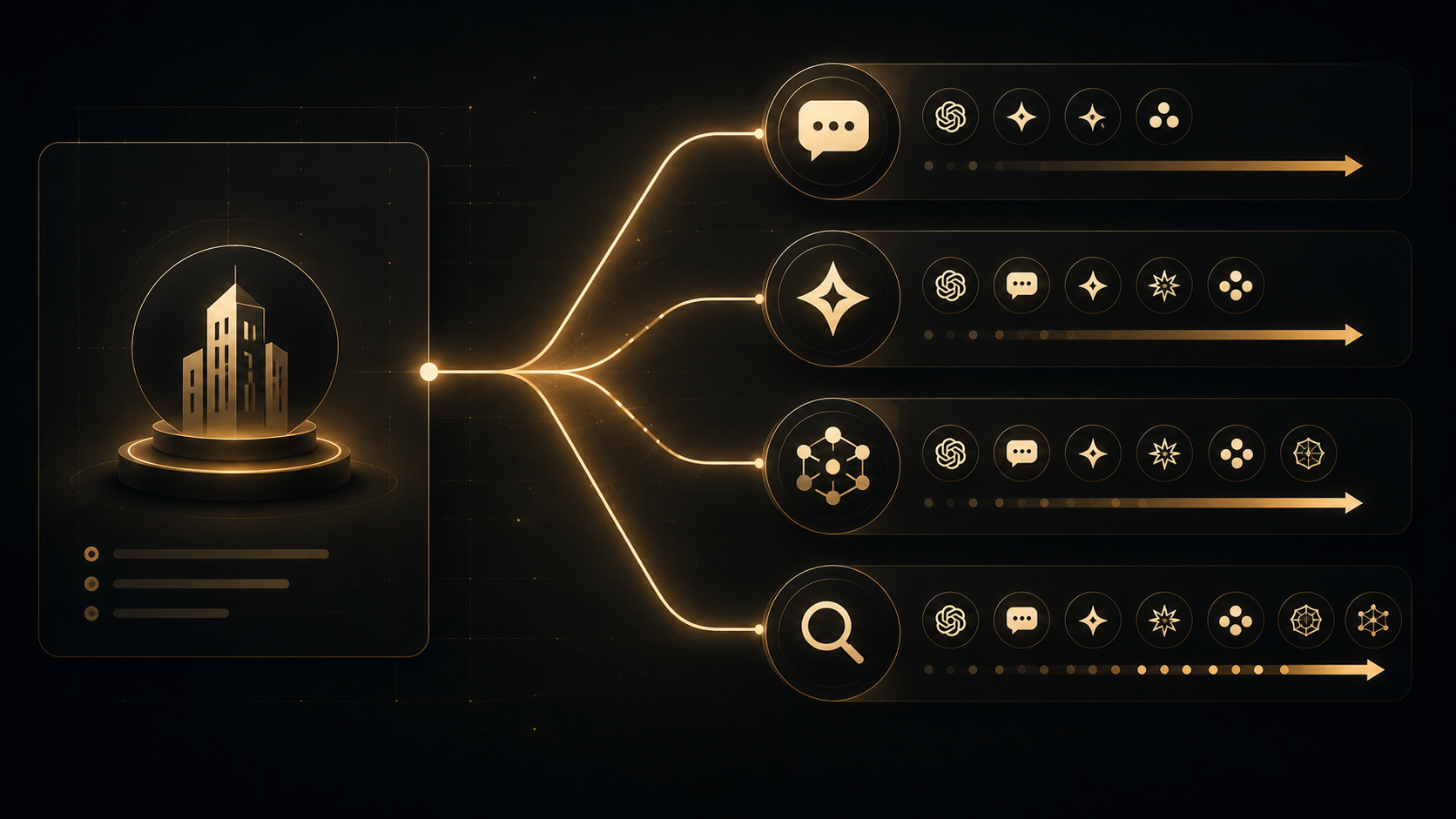
Several strong alternatives to BrightEdge now exist for tracking and improving your brand's visibility across AI search engines like ChatGPT, Perplexity, and Gemini. With AI referral traffic to US retail sites growing 693% year-over-year during the 2025 holiday season (Adobe Digital Insights, January 2026), choosing the right platform matters more than ever.
BrightEdge built its reputation on traditional SEO intelligence, and its newer AI Catalyst product does track AI-generated brand mentions. But it's not the only option — and depending on your goals, it may not be the best fit.
Which platforms compete with BrightEdge for AI search tracking?
The market has expanded rapidly. Peec AI, a Berlin-based startup, onboarded over 1,300 brands and agencies since February 2025 and raised $21 million in Series A funding in November 2025 (The SaaS News). Their focus sits squarely on AI search analytics — tracking how and where brands appear in AI-generated answers.
"AI answers cite the long tail of the web in ways conventional SEO tools miss. Our work shows brands need real-time citation tracking to understand their presence in AI outputs," — Marco Ruiz, Founder & CEO, Peec AI.
Semrush is another serious contender. Adobe agreed to acquire Semrush for approximately $1.9 billion in November 2025, specifically to capture what they called "Generative Visibility" tools. That acquisition signals where the industry is heading.
Other alternatives worth evaluating include Profound (tryprofound.com), which specialises in generative engine optimisation research, and Otterly.AI, which monitors brand mentions across AI platforms in near real-time.
Why should brands look beyond traditional SEO tools?
Traditional search metrics are becoming unreliable proxies for actual visibility. Google search impressions are up 49% year-over-year, yet click-through rates have decreased by 30% (Profound, July 2025). Meanwhile, Gartner predicts traditional search engine volume will drop 25% by 2026 due to AI chatbots.
"This isn't just a shift in where users click — it's a fundamental change in how discovery happens. Brands that rely solely on traditional search metrics risk becoming invisible in AI-driven answers," — Allison Snow, Senior Analyst, Gartner.
The real shift? According to AirOps' 2026 State of AI Search report, 85% of brand mentions in AI answers come from third-party pages, not brand-owned content. Even more striking: 59.6% of AI Overview citations come from pages not in the top-20 organic search results. Your rank-tracking dashboard might show green arrows while your AI visibility tells a completely different story.
What should you look for in an AI visibility platform?
Any credible alternative needs three capabilities: monitoring brand mentions across multiple AI engines, tracking citation sources, and measuring sentiment. BrightEdge's own research found that only 1 in 3 brand mentions in AI-generated responses is positive (BrightEdge AI Catalyst analysis, April 2025). The rest are neutral or negative. Knowing your mention count means little without sentiment context.
ChatGPT alone processes 2.5 billion queries per day as of July 2025 (OpenAI), while Perplexity handled 780 million queries in May 2025. These aren't niche channels anymore. They're where 62% of consumers now trust AI tools to guide brand discovery and decision-making (Exploding Topics, 2025).
How is AI search changing brand discovery?
AI platforms are retaining attention rather than distributing it. Similarweb's March 2026 Generative AI Statistics Report found that AI platform visits grew 28.6% from January 2025 to January 2026, while referrals to external sites remained flat. Brands that only optimise for clicks are missing the point entirely.
Frequently Asked Questions
Is BrightEdge still useful for AI visibility?
Yes, particularly through its AI Catalyst feature. However, alternatives like Peec AI and Semrush offer more specialised generative search tracking that may suit brands focused primarily on AI engine performance.
Which AI search engines matter most for brand visibility?
ChatGPT leads with 900 million weekly active users as of February 2026 (OpenAI). Gemini grew 157% between April and September 2025, reaching 1.1 billion monthly visits (Similarweb). Perplexity is smaller but influential among research-heavy audiences.
Do traditional SEO rankings affect AI visibility?
There's some correlation, but it's weaker than you'd expect. AirOps found that 59.6% of AI Overview citations come from pages outside the top-20 organic results. Strong content structure and authority signals matter more than position alone.
Are free tools available for tracking AI mentions?
Some platforms offer limited free tiers, but meaningful AI visibility monitoring typically requires paid tools. The space is maturing quickly, so expect pricing and feature sets to shift throughout 2026.