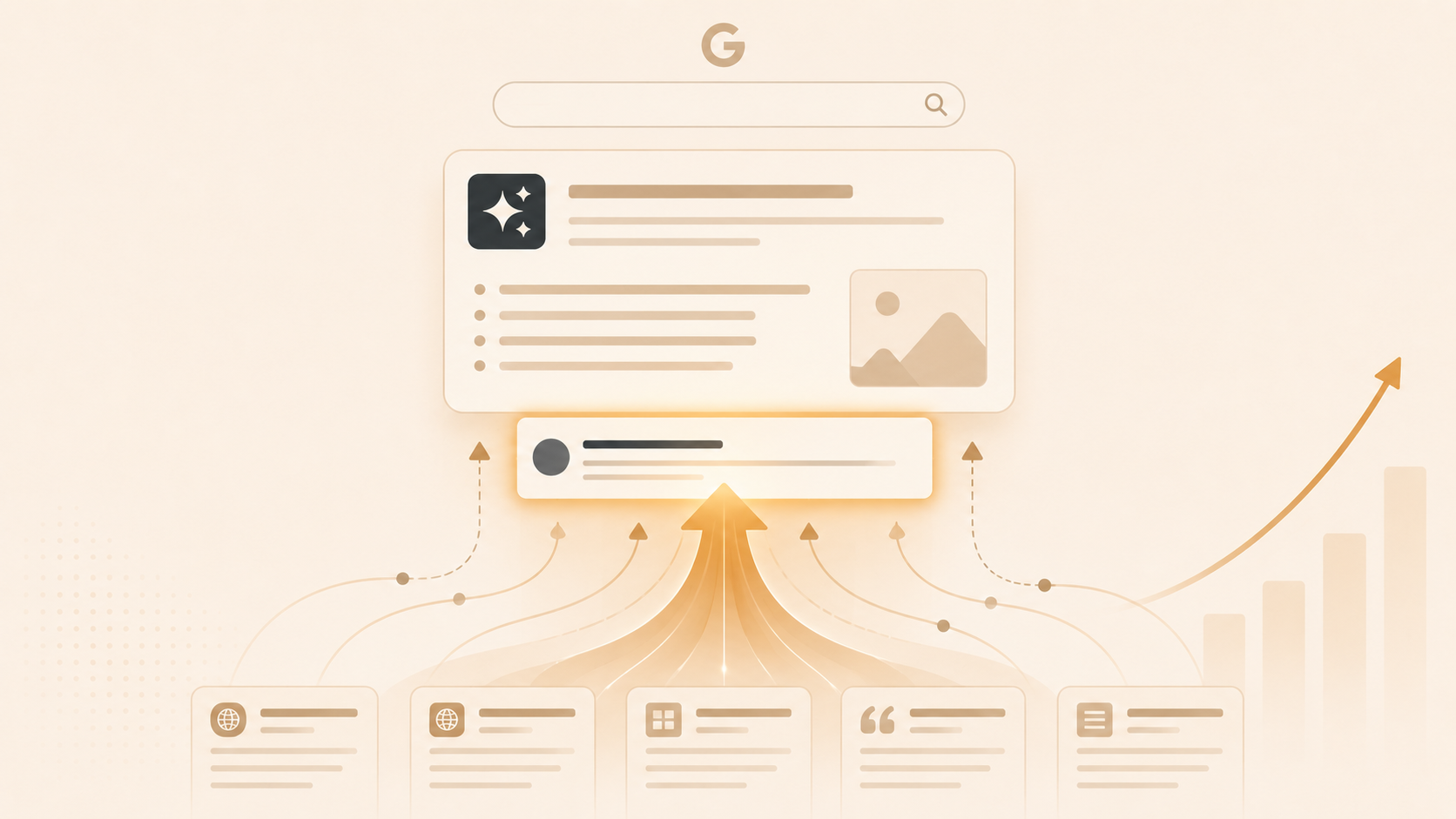

Improving brand visibility in AI recommendations starts with one shift: stop relying on your website alone and build credible mentions across the wider web. That matters because AI systems increasingly answer without sending traffic back. In 2025, 58.5% of U.S. searches and 59.7% of EU searches ended with no click to an external site, according to SparkToro. Meanwhile, Seer Interactive found organic click-through rate fell 61% on queries where Google AI Overviews appeared. If your brand is going to be seen, it needs to be cited inside the answer itself.
"Brand citations are the new links—when answers stand in for search results, being cited inside responses becomes the core signal of visibility," said a SparkToro analyst.
Why does improving brand visibility in AI recommendations matter now?
It matters now because AI search is growing fast while referral clicks are shrinking. OpenAI reported ChatGPT processes 2.5 billion queries per day as of July 2025, and Google AI Overviews query triggering rate rose 102% between January and March 2025, according to Presence AI and Conductor benchmarks.
The commercial impact is already visible. Gartner predicts traditional search volume will drop 25% by 2026 as users move to AI chatbots and virtual agents. Add Semrush’s finding that 93% of AI Mode sessions end without a website visit, and the case is plain: visibility inside AI answers is becoming as important as ranking in classic search.
"Being included inside AI overviews changes measurable outcomes: cited brands see higher organic and paid engagement," said a senior analyst at Seer Interactive.
How do AI systems decide which brands to recommend?
AI systems often pull brand evidence from third-party sources, not just brand-owned content. AirOps and Kevin Indig’s 2026 State of AI Search found 85% of brand mentions in AI answers originate from third-party pages such as review platforms, Reddit threads, industry publications and press coverage.
Consistency is another challenge. The same research found only 30% of brands that appear in one AI answer remain in the next answer for the same topic, and only 20% persist across five consecutive queries. Kevin Indig, Advisor to AirOps and growth strategist, has repeatedly argued that visibility in AI search is an entity problem as much as a ranking problem. In practice, that means AI engines reward broad web recognition, not just tidy on-site SEO.
What actually improves brand visibility in AI recommendations?
The strongest route is to increase credible web mentions, structured proof and expert validation across multiple platforms. Ahrefs data, cited by Superlines, shows brands in the top 25% for web mentions get 10x more AI visibility than average brands. The top 50 brands also capture about 28.9% of all mentions in AI Overviews.
"Our research shows that consistent third-party mentions are the strongest predictors of appearing in AI summaries," said an Ahrefs research lead.
Being cited changes outcomes. Seer Interactive found brands mentioned in AI Overviews earned 35% more organic clicks and 91% more paid clicks than brands not cited. So the job isn’t only to rank. It’s to become quotable, reviewable and referenceable.
That usually means:
- earning coverage from trusted publications
- strengthening review and community presence
- publishing original data or commentary worth citing
- keeping brand facts consistent across the web
- tracking visibility across ChatGPT, Google AI Overviews, Gemini and Perplexity
For baseline guidance on trustworthy content signals, Google’s own search documentation is still useful: https://developers.google.com/search.
What should brands stop doing if they want better AI visibility?
Brands should stop assuming traffic loss means search no longer matters. It means the battleground has moved. Seer Interactive recorded paid CTR dropping 68% when AI Overviews appeared, while Ahrefs reported top organic results saw CTRs 58% lower when AI Overviews were present.
Another weak habit: measuring only rankings. Superlines found citation rates, sentiment and brand mention patterns can vary by as much as 615x across AI platforms. One platform may recommend you often. Another may ignore you. Different systems. Different evidence.
FAQ: Improving brand visibility in AI recommendations
Is website SEO still useful?
Yes, but it’s no longer enough on its own. AI systems frequently cite third-party sources, with AirOps and Kevin Indig finding that 85% of brand mentions come from pages brands do not own.
Do brand mentions really affect AI visibility?
Yes. Ahrefs data cited by Superlines shows brands with stronger web mention profiles get 10x more AI visibility than average brands.
Should brands track more than Google?
Yes, absolutely. Superlines found brand mention behaviour varies up to 615x across AI platforms, so single-platform reporting misses the real picture.
Are AI recommendations stable over time?
No. AirOps and Kevin Indig found only 30% of brands remain in the next answer for the same topic, which makes ongoing monitoring essential.