By Alex Morgan — Head of AI Search Research (12 years in AI search and information retrieval)
The tools you need to improve brand presence in AI answers fall into three categories: AI search monitoring platforms, content optimisation software, and structured data generators. Getting this right matters now more than ever — 50% of consumers already use AI-powered search as a primary information source, according to the McKinsey AI Discovery Survey (August 2025), and 44% of them never bother clicking through to a website.
"AI answers increasingly cite third-party sources; brands that treat AI visibility as an earned-media problem win the long game." — Kevin Indig, author, 2026 State of AI Search Report
That last figure should stop you cold. If your brand isn't surfacing in the AI-generated answer itself, you're invisible to nearly half your potential audience.
Why do brands struggle to appear in AI answers?
Most organisations simply aren't tracking the right signals. Only 16% of brands systematically monitor their AI search performance, leaving an 84% readiness gap (McKinsey & Company). Traditional SEO dashboards weren't designed for a world where 58.5% of US searches end without a single click to an external website (OmniBound AI Search Statistics, 2025).
Making things harder still, 85% of brand mentions in AI answers originate from third-party pages rather than owned domains (AirOps / Kevin Indig, 2026 State of AI Search Report). Your website alone won't carry you.
Which tools monitor brand visibility in AI search?
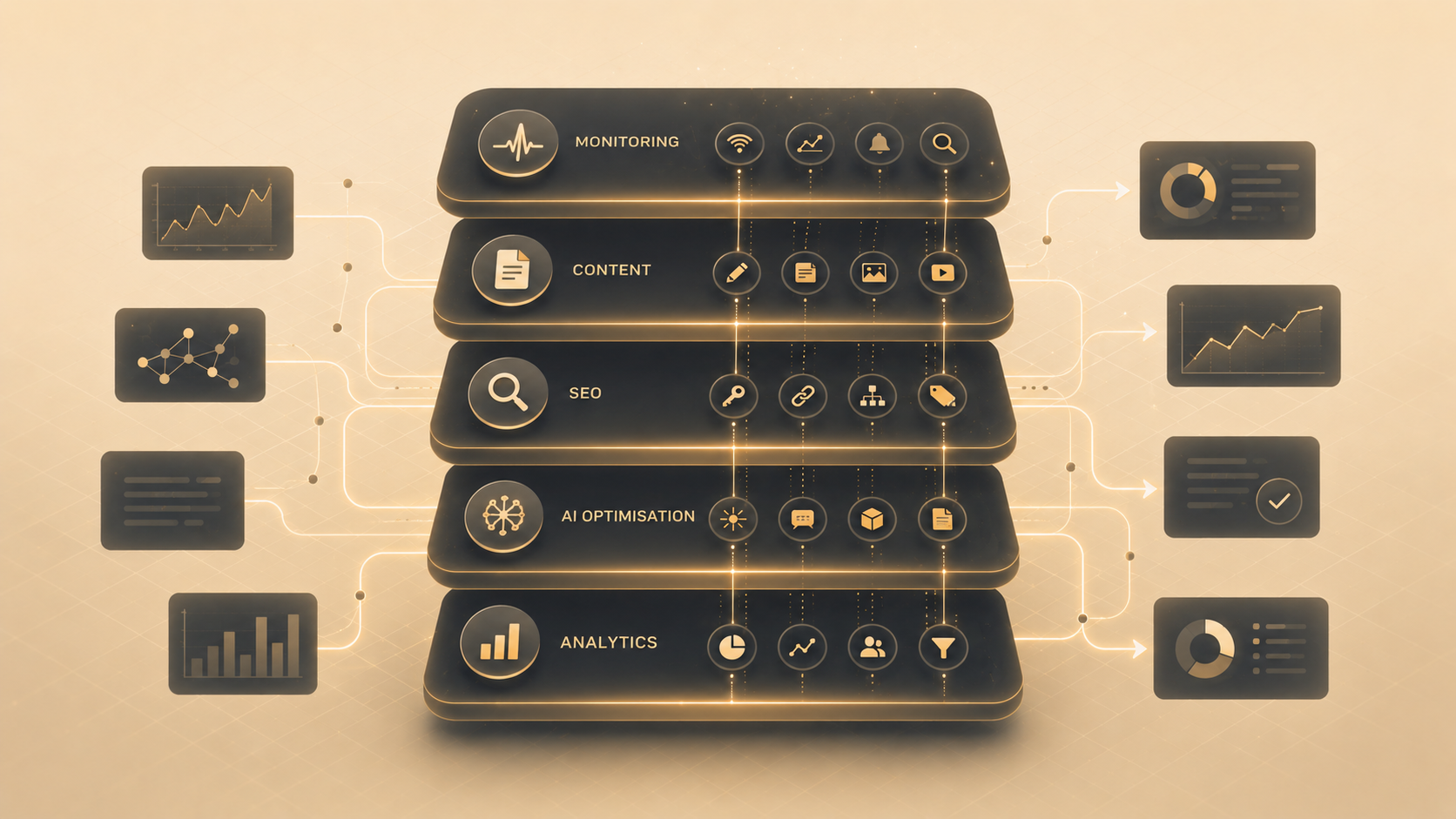
Several tools now track how often — and how accurately — AI engines reference your brand. Platforms like OmniBound, Profound, and Peec AI scan responses from ChatGPT, Google AI Overviews, and Perplexity to measure mention frequency, sentiment, and citation sources. Brandwatch and Otterly.AI offer similar monitoring with competitive benchmarking layered on top.
Choosing the right monitoring tool is step one. Here's a practical sequence:
- Audit your current AI visibility across at least three engines (ChatGPT, Perplexity, Google AI Overviews) using a dedicated tracker.
- Map the third-party sources AI engines already cite for your target queries — remember, brands' own websites account for only 5–10% of AI-referenced sources (McKinsey).
- Prioritise content updates on those high-citation third-party platforms, including review sites, affiliate publishers, and industry directories.
- Implement structured data markup (FAQ schema, HowTo schema, organisation schema) on owned pages to improve extractability.
- Front-load key claims in your content's opening 30% — SparkToro research (January 2026) found that 44.2% of LLM citations are pulled from the first 30% of a page's content.
How does content structure affect AI citations?
Content structure affects AI citations dramatically. Pages with sequential headings and rich schema markup appear more frequently in AI-generated responses, while 83% of AI Overview citations come from pages outside the traditional top-10 search results (Search Engine Land, 2025). This means well-structured content on a mid-authority domain can outperform a household name with poor formatting.
Write sections that answer one question completely. AI engines extract sections, not articles.
What's the business cost of ignoring AI search?
"If brands don't measure presence inside AI answers, they risk losing consideration before a customer ever reaches their site — presence in the answer is the new reach metric." — David Court, Senior Partner, McKinsey & Company
The financial stakes are enormous. McKinsey projects $750 billion in consumer spend will flow through AI-powered search by 2028. Meanwhile, AI referral traffic to US retail surged 693% year-over-year during the 2025 holiday season (Adobe Analytics, January 2026). Brands that invest in the right tools now are positioning themselves where purchasing decisions increasingly begin.
Conversely, brands see a 61% drop in organic click-through rate when AI Overviews appear on their target queries (OmniBound, 2025). Doing nothing has a measurable cost.
Frequently asked questions
- What are the best tools for tracking brand mentions in AI answers?
OmniBound, Profound, Peec AI, and Otterly.AI each offer AI search monitoring with citation tracking across ChatGPT, Perplexity, and Google AI Overviews.
- Do traditional SEO tools work for AI search optimisation?
Not fully. Traditional tools measure rankings and clicks, but 93% of Google AI Mode sessions end without a website visit (OmniBound, 2025). Dedicated AI visibility tools fill the gap.
- How quickly can brands improve their AI search presence?
Structured data improvements and content reformatting can influence AI citations within weeks. Building third-party authority — through reviews, partnerships, and earned media — typically takes three to six months of consistent effort.
- Does schema markup help with AI answer visibility?
Yes. Pages using FAQ and HowTo schema alongside sequential headings are more frequently extracted by AI engines, even when they don't rank in the traditional top 10.